IELTS Writing Test Result
Academic Writing: Price of Metal (Line Graph) / Tourism (Advantage - Disadvantage)
Your Band Score
41:01
Assessment Criteria
Task Achievement
4
Coherence & Cohesion
4
Lexical Resource
4
Grammatical Range & Accuracy
4
AI-Powered Insights
Get personalized feedback on your performance
Task 1 Evaluation:
Strengths:
- You attempted to summarize overall trends and make comparisons between nickel, zinc, and copper.
- Some data points are mentioned.
Areas for Improvement:
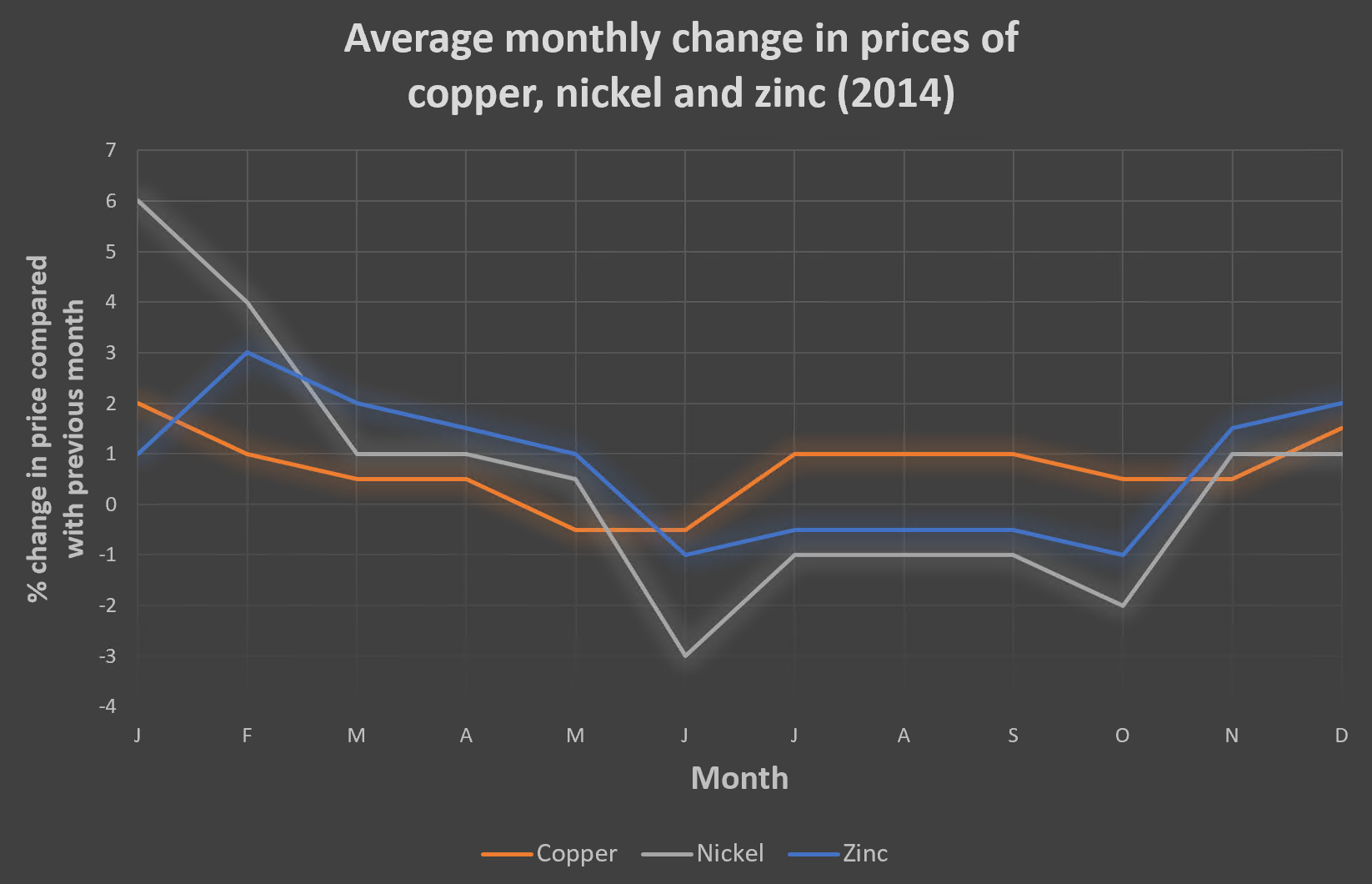
- Data Accuracy: Many figures are unclear or incorrect (e.g., copper’s move to -15%). Ensure you read the axes and values correctly.
- Task Response: You need to highlight the main features clearly (e.g., major rises, falls, and relative volatility) and avoid repetition.
- Coherence & Cohesion: Organize your report into clear paragraphs (overview, key features) and use a wider range of linking words to connect ideas.
- Lexical Resource: Avoid repeating words like “portion” and “ratio.” Use terms such as “percentage change,” “fluctuation,” “peak,” and “trough.”
- Grammar: Work on sentence structure and accuracy (e.g., subject-verb agreement, correct prepositions).
Suggestions:
- Start with a clear overview of the overall trend, then describe notable peaks and troughs for each metal.
- Use specific data to support each point and compare metals directly.
- Practice writing 150–180 words to fully cover the task.
IELTSpot is here to support your progress with guided practice—and you’re on the right track!
Just stay on this result page, click the chat icon, and send a message referring to this result so we can dive deeper and create a strategy to improve each section.
Answer Recommendation
Task 1
Question
The graph below shows the average monthly change in the prices of three metals during 2014.
Summarise the information by selecting and reporting the main features and make comparisons where relevant.
Write at least 150 words.
Answer
Overall, nickel experienced the most volatility, with significant fluctuations throughout the year, while copper remained relatively stable, and zinc showed moderate but consistent movements. All three metals followed similar downward trends mid-year, followed by recovery towards the end of the year.
In January, nickel prices surged dramatically, reaching a peak of around 6%, whereas copper and zinc also saw modest increases, at approximately 2% and 1% respectively. From February to May, nickel’s rate of increase declined steadily, dropping to about 1%, while zinc followed a mild downward trajectory and copper hovered consistently near the 1% mark.
A notable drop occurred in June, when all three metals experienced negative price changes. Nickel faced the sharpest decline, falling by nearly -3.5%, while copper and zinc both dipped slightly, by about -1% each. In the following months from July to September, copper rebounded, stabilizing around +1.5%, whereas nickel and zinc remained flat or showed slight negative changes.
In October, another dip occurred for nickel and zinc, declining by approximately -2% and -1% respectively, while copper maintained its steady performance. The final two months of the year witnessed a general recovery, with nickel and zinc rising by about 2–3%, and copper increasing modestly to around 1.5%.
In conclusion, nickel exhibited the most erratic behavior in terms of monthly price changes, while copper showed minimal variation, and zinc followed a pattern of moderate fluctuation with eventual recovery.
Task 2
Question
Write about the following topic:
These days it is much easier for many people to travel to different countries for tourism than in the past.
Do the advantages of this development outweigh the disadvantages?
Give reasons for your answer and include any relevant examples from your own knowledge or experience.
Write at least 250 words.
Answer
One of the most significant benefits is the promotion of cross-cultural understanding. When people travel to different countries, they are exposed to new traditions, lifestyles, and perspectives. This fosters global awareness, tolerance, and mutual respect. For instance, visiting countries with vastly different customs can challenge stereotypes and reduce xenophobia. Moreover, international tourism plays a vital role in economic development, especially for developing nations. Countries like Thailand and Morocco rely heavily on tourism as a source of employment and foreign income, which can lead to improved infrastructure and living standards.
Additionally, modern technology and transportation have made travel more efficient, affordable, and safer than ever before. Budget airlines, online accommodation platforms, and travel apps have opened the doors for people of various socioeconomic backgrounds to explore the world. This democratization of travel allows for personal growth and education beyond classroom walls, particularly for young travelers.
However, some drawbacks cannot be ignored. Overtourism can lead to environmental degradation, such as pollution and damage to historical sites. Furthermore, the commercialization of culture may reduce local authenticity. Despite these issues, many governments have started implementing sustainable tourism policies, such as limiting visitor numbers and promoting eco-friendly practices.
In conclusion, while international tourism poses certain challenges, its positive impact on cultural exchange, economic growth, and personal development clearly outweighs the disadvantages. With responsible management, the world can continue to enjoy the benefits of easier global travel without compromising local communities or ecosystems.
Answer Submitted
Task 1
Question
The graph below shows the average monthly change in the prices of three metals during 2014.
Summarise the information by selecting and reporting the main features and make comparisons where relevant.
Write at least 150 words.
Answer
Overall, the price of metal has declined from the starting month to the ending month. In the month January the portion of nickel was about 6% but at last it has downfall up to 1%. Talking about the metal zinc the portion of it has been slightly increased on the month February but decreased up to the ending month December and its portion has reached up to about the 2%. Meanwhile, the ratio of copper has decreased from 2% to around -15 and increased a bit up to 2%.
In contrast, the portion change in the cost of metal has turned down from the beginning of the month to the ending of the month. Although, the percentage change in the price of copper is great in comparison to other metals nickel and zinc.
Task 2
Question
Write about the following topic:
These days it is much easier for many people to travel to different countries for tourism than in the past.
Do the advantages of this development outweigh the disadvantages?
Give reasons for your answer and include any relevant examples from your own knowledge or experience.
Write at least 250 words.
Answer
I believe that there is more advantage than disadvantage.
Firstly, Tourism develops the global understanding and cooperation between the two different nations which plays the great role in the development of the nation. In addition, National and international tourist helps in the growth of a country's economy especially in its tourism industry. For instance, Tourist travelling to different place spend money on hotels, food, shopping and in entertainment which helps to generate income. Due to the advancement of technology it has been much easier for tourist to search about different beautiful places have knowledge about it before having trek there. Nowadays, the world has been moved forward than the past years so it is very easier for tourist to travel through one place to another with different transportation facilities like air way, road way, railway and through water. Tourism helps to know about each other's cultural values trend and fashion etc.
On the other hand, tourism has create bad effect on the society following the foreign trend and culture and ignoring the national one. Tourist without discipline pollute the environment, damage the natural habitats, harm the wildlife reserve. Moreover, there may be risk of theft, rubbery and murder cases. They can copy the others idea of generating the income. Hence, this kind of disadvantages can have during tourism.
In the conclusion, there is the great number of benefits for easy and convenient method of travelling to different countries for tourism sector because of development of various sectir like transportation and other technical sector.
Share Your Result
Copy and share this link with your friends or tutors.